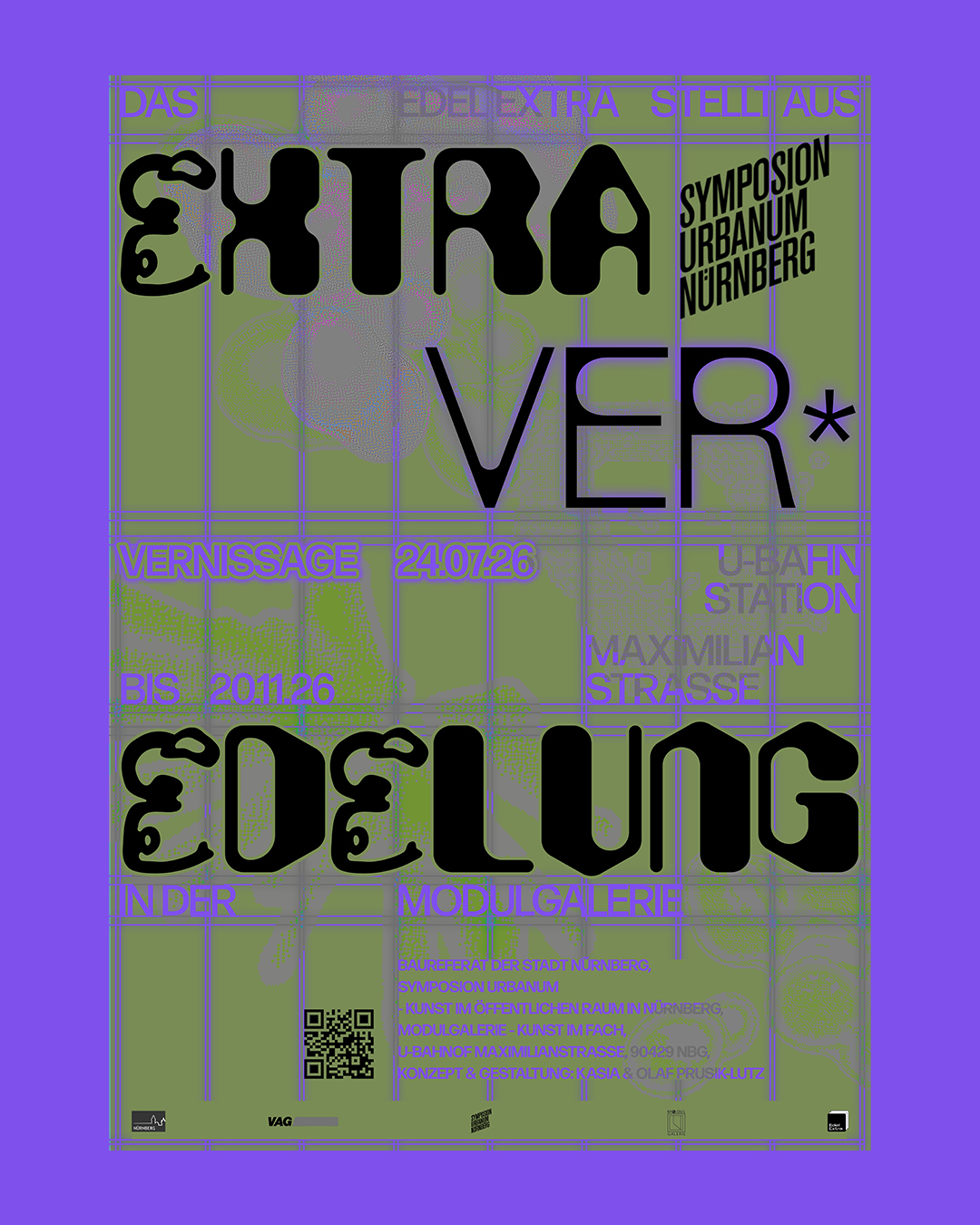
Edel Extra takes over the Modulgalerie
I have always liked exhibition spaces that make you look at art a little differently. The Modulgalerie in Nuremberg is one of those places. Instead of a traditional gallery space, it uses old luggage lockers as small individual exhibition spaces, turning something that was once purely functional into a place for art.For the current exhibition, the people who are usually busy organising exhibitions at Edel Extra have become the exhibitors themselves. From 24 July to 20 November 2026, the 48 lockers of the Modulgalerie show works by the active members of Edel Extra e.V., bringing together very different artistic approaches, backgrounds and ways of working.
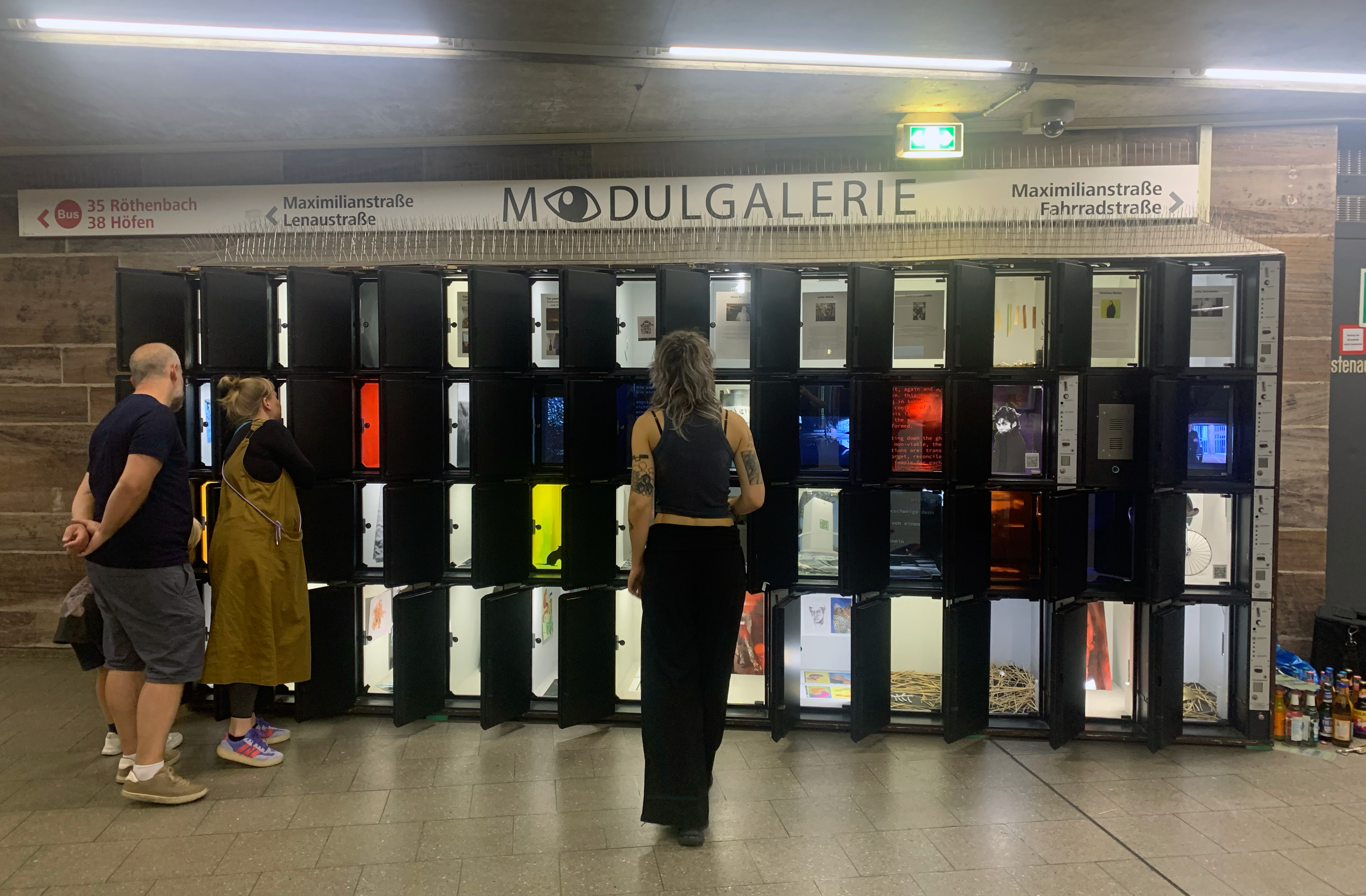
Photo: Christine Meiler
From luggage lockers to gallery
The Modulgalerie, Kunst im Fach, was created by artists Kasia Prusik Lutz and Olaf Prusik Lutz as part of Symposion Urbanum 2021. They transformed the old luggage lockers of the former Lorenzpassage into a gallery, while keeping much of the original retro character of the lockers. I really like this idea because the space itself already has a story. Each locker is small, defined and a little unexpected as a place for art. At the same time, the many individual compartments make it possible to bring together a large number of works without trying to make everything look the same. New exhibitions and art actions are presented in the Modulgalerie every four months, with artists invited to respond to the unusual setting in their own way.
This time, Edel Extra is showing its own work
For this exhibition, the Modulgalerie is working together with Edel Extra e.V., a non profit organisation dedicated to supporting artistic and aesthetic processes. Edel Extra runs its own exhibition space in Gostenhof, where local and international artists, initiatives and institutions can present exhibitions, performances and readings. What I find particularly interesting about this exhibition is the change of perspective. The people who are normally involved in making exhibitions happen are now part of the exhibition themselves. The result is not one shared artistic style, but a collection of very different positions. Sound, photography, film, animation, sculpture, text and mixed media all have their place in the 48 lockers.
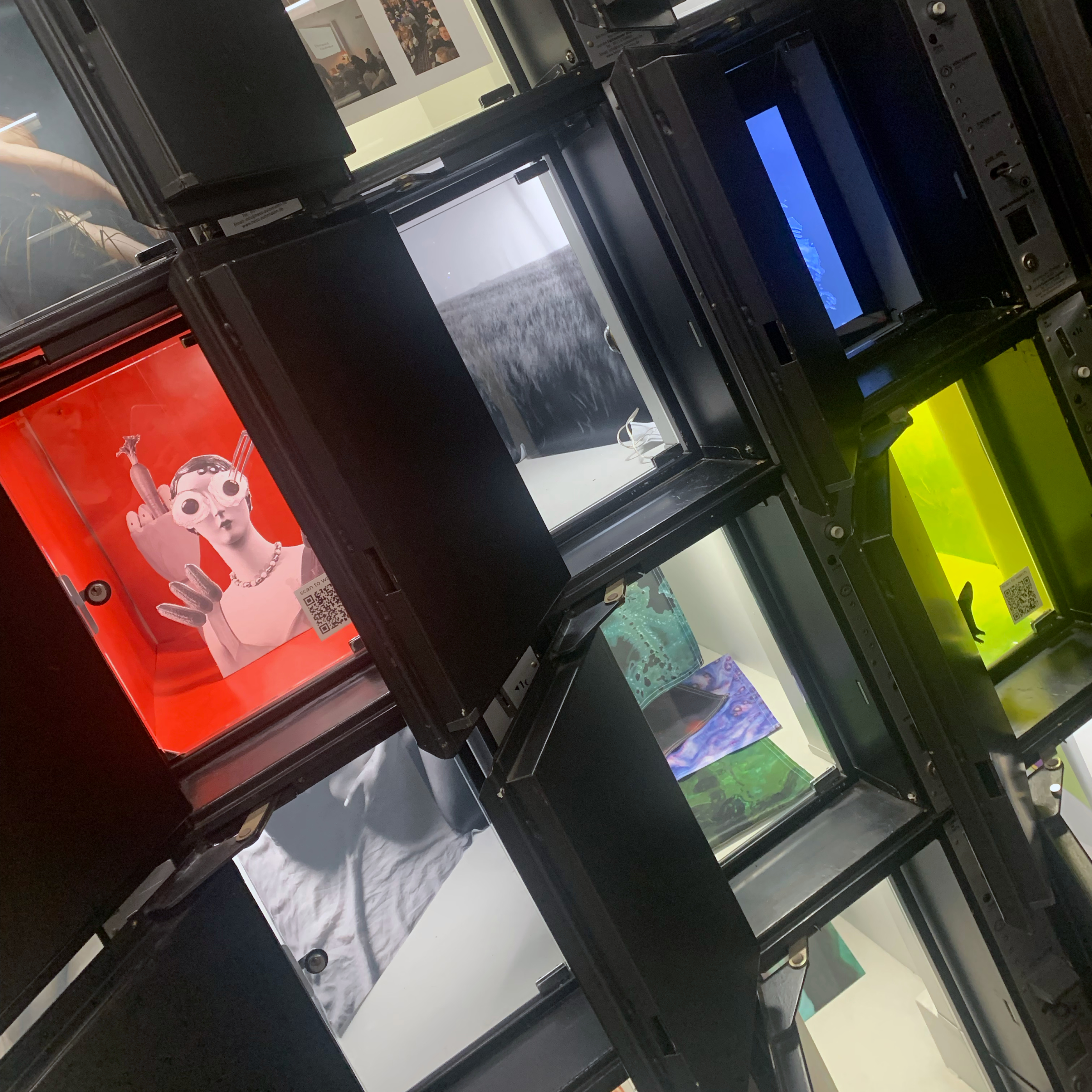
Photo: Christine Meiler
A group with very different approaches
The artists involved are Alicia Brunner, Quinn Maier, Annett Stenzel, Christine Meiler, Luise Sébök, Kathrin Inzenhofer and Julia Savchenko. Their backgrounds and practices are quite different. Alicia Brunner works between organic and digitally generated imagery, with a particular interest in CGI, AI and visual experimentation. Quinn Maier has worked with photography for many years and combines it with music, poetry and film to explore emotion, memory and vulnerability. Annett Stenzel works across film, photography and painting, often looking at social relationships, power structures and the way images shape our perception. Christine Meiler works with motion design, animation and video, combining illustration and mixed media with stories and sometimes a good dose of humour. Luise Sébök works across typography, video, sound, 3D and other mixed media, with recurring interests in nature, femininity and visual experimentation. Kathrin Inzenhofer approaches her work from a background in chemistry, exploring the space between science, nature, disappearing techniques and artistic transformation. Julia Savchenko works with text, graphics and drawing, creating what she describes as a kind of literary underground world, exploring what sits outside the visible.
Different works, one small space
What I enjoy about group exhibitions is exactly this kind of contrast. You don't necessarily need every work to fit together. Sometimes it is more interesting when it doesn't. In the Modulgalerie, this becomes particularly noticeable because of the way the space is organised. Each work has its own small compartment, but at the same time all 48 lockers become part of one larger exhibition. You move from one artistic approach to another within just a few steps. I like that you can discover the works one by one. Some might catch your attention immediately, while others might make you stop for a little longer. There is no single way of moving through the exhibition, and no need to understand everything at first glance. For me, this is one of the nice things about a group exhibition. You get to see how very different ideas can exist alongside each other. Photography can sit next to animation, text next to sculpture, or a digital work next to something much more physical. The differences don't necessarily separate the works, they make you notice each one more clearly. The small size of the lockers also changes the way you look at the work. You are not standing in front of a huge gallery wall with lots of space around you. Instead, each locker creates its own little moment. You open one up, look inside, move on to the next, and gradually get a sense of the different people and practices that make up Edel Extra.